


Paris presents 2021 budget, set to adopt Monday
News December 27, 2020
BLAIRSVILLE, Ga – In a public hearing for the 2021 budget, Sole Commissioner Lamar Paris presented the $21,748,780 budget. It will be adopted on December 28 at 4:30 p.m. at the Union County Courthouse.
The budget featured an 11.7 percent increase from 2020, which was $19,462,648. The reasons for the increases included three percent pay raise to county employees (+$440,000), property reevaluation (+$380,000), county’s potential share of gun range expenses (+$500,000), state cutting budgets (+$70,000), health care costs (+$100,000), vehicle and equipment repairs (+$20,000), repairs and maintenance (+$22,000), vehicle purchases (+$40,000), retirement plan matching (+$36,000), LMIG grants (-$104,000), operating costs for the new sports center, and COVID-19 expenses.
The county had to raise financing for the library, health department, court system, and other partially state-funded organizations because the state cut budgets by 15 percent.
The $500,000 budgeted for the gun range could decrease depending on the outcome of the project. DNR listed exacting specifications to receive aid.

copy of the 2021 budget
Several departments and offices experienced a budget escalation from 2020 with a few decreasing such as elections and health. The three percent employee raise and accounting for state budget cuts account for some of the increases.
“Every year our department heads and elected officials submit their budget requests to our office. We go through all the numbers and items compared to previous years budgets and actual expenditures and cut anywhere possible to get our total budget as low as we reasonably can. However, this is a difficult task because all our county offices and departments do an outstanding job each and every year to be practical and responsible with our budgets.” Paris stated.
County revenues grew in 2020 as well. SPLOST collections well outpaced previous years with November reaching $528,176.50.
The millage rate was set in the summer and increased to 7.361 mills. The overall increase will be 6.8 percent on the school property taxes are factored in. A homestead property with a market value of $100,000 will see a $46.25 tax hike. A non-homestead property valued at $200,000 will experience a $97.26 tax increase.
For years, Paris kept the millage rates low to save property owners money, but the county found it necessary to raise the millage rate this year to replenish the fund balance and cover operating expenses. According to the commissioner, if the counties maintained previous millage rates, Union County’s new rate would still rank in the lowest 10 percent in Georgia.
“Property tax revenue in 2020 was short almost $1 million dollars,” Paris explained.
The tax increase generated $1,629,229.
He also addressed the need to raise salaries for the sheriff’s office, jail, 911 dispatch to keep employees in the county. Paris thanked Sheriff Mack Mason for trying to keep costs low.
A state-required county property reevaluation is currently underway, so the millage rate could drop next year. The cost of the reevaluation is $380,000.
Union County Schools approves 2021 budget
News, Panther's Corner September 29, 2020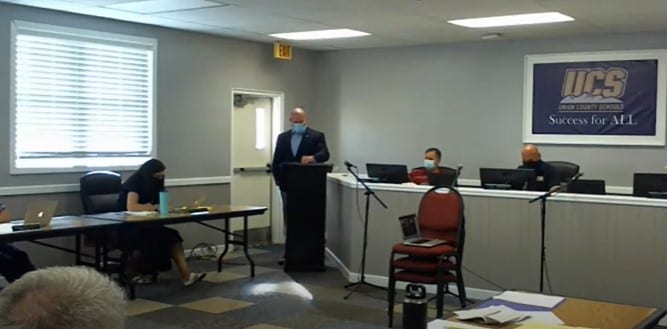
BLAIRSVILLE, Ga – Union County Board of Education approved the fiscal year 2021 operating budget during the September meeting. The approved budget matches the previously presented tentative budget.
“The challenges we faced in this budget is the very large TBE cut for the state of Georgia…and the added cost of mitigation for COVID-19, which is very costly. We’ve spent several hundred thousand dollars thus far in mitigation strategies,” Superintendent John Hill stated.
Some mitigation tactics include cleaning products, masks, plexiglass, air filters, and PPE to ensure students, faculty, and staff’s safety.

UCS didn’t raise taxes, and all current Union County Schools (UCS) employees will receive their same pay rate. No one will see a pay cut.
As for the CTAE Budget and goals for 2021, the program now falls under Perkins Five for the federal government money. Perkins Five money for Union is $27,199, and some of that goes toward professional development. The state cut agriculture grants by 10 percent. However, the state superintendent is using some of the CARES Act funds to address those state cuts.
“We’re developing a five-year plan for the College and Career Academy, which includes the [facilities] grant,” said Director Josh Davis.
CTAE is also working around COVID-19 to keep students active and learning in different programs this year.
Policy Updates
Additionally, the board of education approved updates to four of the school system’s policies: equal education opportunities (JAA), sexual harassment of students (JCAC), equal opportunity employment (GAAA), sexual harassment of employees (GAEB).
The U.S. Department of Education Office of Civil Rights issued new Title Nine regulations regarding sexual harassment. The policies went into effect in August, and UCS needed to update its protocols to comply with federal laws. JAA and GAAA are now 10 page polices. Each one provides detailed and legally binding rules on how the school should manage to sexual harassment claims, promptness of response, and overall handling of the case.
“They obligate us to respond promptly and supportively to the alleged [sexual harassment victim.] What we have doesn’t get near enough to what it’s supposed to be now. We now have more specific definitions, response expectations,” explained Assistant Superintendent David Murphy. He added, “In fact, for students, if you draw a paycheck from the school district, you are now a mandated reporter for sexual harassment for students.”
School leadership also participated in training to better understand all federal requirements for these policy updates.
How does the public feel about recent property purchases?
News September 1, 2020
BLAIRSVILLE, Ga – The raucous crowds at the three property tax budget hearings wanted more information on the two recent purchases for the Hill Property for a little less than $750,000 and the Old Shoe Factory for $800,000.
According to Sole Commissioner Lamar Paris, neither of these purchases affected the decision to raise property taxes in 2020. However, attendees still needed to know why make these decisions back to back.
- See the reasons behind the tax increase, here.
“Why are we still buying all this property for the future? I understand the jail,” asked one attendee. “I understand the jail, but I don’t see a whole lot of companies lining up to buy that property at the shoe factory. Why can’t we put that off until we have the new property evaluated?”
The Old Shoe Factory was purchased using SPLOST funds, which can’t go toward operating expenses or certain maintenance costs. SPLOST goes toward capital outlay projects, such as parks, roads, schools, and public facilities. It also doesn’t affect the 2021 budget in any way, and the property is financed for six months, with half down at the time of purchase. They couldn’t finance the Hill Property.

Some citizens asked for greater transparency and tried to find a solution.
“No way I would have contracted for [those two pieces of property] if I felt like I had a choice,” stated Sole Commissioner Lamar Paris.
According to Paris, the Old Shoe Factory owners were dissolving the property and putting it on the market. Sheriff Mack Mason told Paris it would be the perfect place for a jail at a valuable price. However, they don’t anticipate building a jail for another five to eight years. In the past, Union County has paid around $300,000 to other facilities to house local prisoners. After talking with judges and district attorneys, they found a way to drop costs to approximately $80,000.
The current Union County jail can hold 54 inmates, but it typically houses 70 to 80, plus those that stay in other facilities. With COVID-19, the jail population is down due to executive orders to keep jail populations low.
“One of the hardest things in the world is to find where you can put a jail,” the commissioner added. “I’m hoping it will be way down the road. With the sheriff’s insistence, we felt like we’re saving the county money in the long run.”
No one wants a jail near their homes, but the Old Shoe Property is close to the existing jail and fire department with room for expansion.
Another gentleman, who works for local law enforcement, agreed with the Old Shoe purchases because the current jail is out of space. Training is impossible at the existing facility. They must go somewhere else to train deputies.
Also, a new facility has the potential to bring in revenue. built to federal specifications, Union could house federal prisoners and earn money from the federal government.

Others expressed their displeasure with Commissioner Paris, the tax increase, and the new county properties.
Hill Property
As for the Hill Property, the county previously budgeted for it and paid $150,000 beneath the appraised value. Union General Hospital owns the surrounding 500-plus acres, and a few people asked why didn’t the hospital purchase it?
According to Paris, the UGH couldn’t make that purchase due to COVID-19. The pandemic resulted in a financially strapped hospital that had to lay off people in the spring. In the future, the hospital could purchase the Hill Property from the county or vice versa. It provides options to both entities for either a retirement community, a new nursing home, or something else.
The commissioner expressed many in Union County express a desire for a retirement community.
“It’s one of the few things we don’t have in this county that we sorely need,” Paris added. “We feel this development is a very good possibility for the future in the next three to five years. We take a large tract of property currently exempt from property tax rolls now and have it developed and sold to the retirement village with individual homeowners and property taxpayers.”
Pat Shafer, one of those who wanted a retirement village, spoke at the third public hearing. “We have places for lower-income people, but I make too much in my retirement…There’s no place for us to go. I’m by myself now. What do I do? Do I go ten miles out of town?”

Pat Shafer would like to move to a retirement community, but Union County currently doesn’t have one.
Another attendee pondered if the promise of a retirement community in the near future was misleading because of the Hill Property’s life trust. The project might not start for five years unless something changes.
In each hearing, crowds echoed that the purchases and tax increase were “too much at once” and “looked bad.”
However, many also agreed that Paris had done a great job managing the county. They liked the dog park, new pavilion at Meeks Park, Pickleball court, and double gym. Attendees were in favor of the advancements made in Union.
They also asked for transparency in budgetary decisions, such as purchasing a property. However, county governments often conduct these discussions in executive sessions to prevent others from buying it and driving up the price.
“I’ll make sure that my staff and I really work on [how we could possibly do that],” Paris said regarding property purchase transparency.
He also discussed the possibility of a county budget community that would work with the finance staff.
“All I can do is look at what we have done in the past and know that we use the same process now as we’ve always used. [We] listen to as many people, not going out to the public because [it’s a property purchase,]” explained Paris.
The county does talk to real estate agents and certain community members to help it decide on property purchases. Paris added people could be added to a list if they wanted to be involved in the purchasing decision process.
“We’re going to watch every penny this year, tighter than we’ve always watched it, and we’re going to try and see if there are ways to cut this next year. We just couldn’t take a chance of our fund balance going so low and impacting our credit,” Paris ended.
Union County Schools preparing for state budget cuts
Board of Education, Community May 20, 2020
BLAIRSVILLE, Ga – Union County Schools getting ready for state budget cuts in wake of the COVID-19 pandemic and accompanying shutdown.
During the Superintendent Update of the May 19, 2019 board meeting, Superintendent John Hill addressed the statewide cuts of 14 percent for the fiscal year of 2021.
“Please be aware that we are following that very closely, but at this point in time, we don’t have any valid information concerning the budget. We will not get our allotment sheet from the state until after the Legislature has met,” Hill explained.
The current plan is for the 2020 legislative session on Thursday, June 11, 2020, with offices reopening on June 1. Until the General Assembly finalizes the 2021 budgets, it’s difficult for schools to proceed.
Gov. Kemp’s office released the following information concerning state revenues for April 2020:
“The State of Georgia’s April net tax collections totaled nearly $1.84 billion for a decrease of $1.03 billion, or -35.9 percent, compared to April 2019 when net tax collections totaled $2.87 billion. Year-to-date net tax collections totaled $19.23 billion for a decrease of nearly $680 million, or -3.4 percent, compared to the previous fiscal year (FY) when net tax revenues totaled $19.91 billion.”
Georgia’s constitution states that is must have a balanced budget for each fiscal year, but the loss of revenue due to the COVID-19 shutdown will likely see several programs in education and elsewhere suffer.
“I do want everyone to know that we’re doing everything we can to take care of our employees and continually provide the high standard of quality for our students,” stated Hill.
In the May 7 called board meeting, board members unanimously approved the allocation of $527,000 in CARES Act Funds to 2021 salaries and benefits to offset the state reductions.
Georgia public school district received a total of $411,452,867 in CARE funding from the federal government to combat shortfalls due to the COVID-19 shutdown.
In a release from Georgia Department of Education (GaDOE) concerning CARES, it clarified:
“The CARES Act funds are flexible in nature; districts can use them for a wide variety of efforts including distance/remote learning, school meals, supporting at-risk student populations, mental and physical health, supplemental learning, facilities/equipment, and maintaining continuity of core staff and services. The funds can be used to reimburse expenses retroactive to March 13, 2020, and do not expire until September 2022.”

CARES Act Funding graphic courtesy of GaDOE
Surrounding school systems are in the same boat as Union County and are currently waiting to see what the legislature does before making any decisions.
The board also confirmed the certified rehires for the next school year.
End of School Year
As for the end of the 2019-2020 school year, Hill also commended Union County Schools for bringing all students up to proficiency before the end of the year. The high school had 68 students in remediation. All seniors met graduation requirements. Primary school hosted one on one online meetings to help children meet all goals. The elementary school has also moved almost all their students up to As and Bs. Woody Gap’s students are all at proficiency. Union County Middle School (UCMS) will hold a virtual award ceremony next week over Google Classroom.
UCMS Theatre Arts also aired a program “10 Ways to Survive During Quarantine.”
GaDOE left it up to local schools to determine proficiency in a subject and offered grading guidelines. Students are allowed to submit an assignment multiple times, a “no zero” policy for any homework issued after schools closed, option for assignments to be marked as compete or do not complete, establish competencies from before closure to identify a cutoff date and benchmark for course completion, and prioritize seniors, K-3, and at-risk populations for direct instruction.
$2M UCS Field House Under Reevaluation
News, Panther's Corner May 25, 2019Blairsville, Ga – New field house being reassessed after bids come in $1M over the initial budget.
Board of Education elected to reevaluate the scope of the field house project after bids for came back around $2M.
“I had anticipated a million. This is way more than I anticipated,” stated Chair Cynthia Odom.

Board asked for options on the new field house.
“When we started out the architects the number was a lot lower, but it seems like it has grown and grown with its costs and we actually value engineered practically everything,” explained Assistant Superintendent David Murphy.
Superintendent John Hill offered to go back and reevaluate the specifications, including the architectural drawings and RFP to find a reasonable solution.
Odom suggested looking at the current fieldhouse and trying to modify it before proceeding with this project.
“We’re a pay as we go,” said Odom, “It’s going to delay other items.”
Board Member Keith Potts added another approach to the field house project, “Maybe the footprint of it can be what you’re looking at, but downsize the building so you can expand maybe in five years to get that number down.”
These bids for the project came in last week, and due to architecture fees, the school system’s already paid over $50,000 into it. The bidding was very tight among the lowest three within $50,000.
“It’s a terrible time to build,” stated Hill.
“It’s hard to justify the costs of double, $2M on a non-academic building, used by a finite number of students,” said Board Member Janna Akins.
“We need to provide a facility, but we can reevaluate exactly what that is,” stated Hill.
Odom the discussion closed with, “We appreciate all the time, effort, and energy. I know this is not an easy thing to do.”
Safety access doors for all the schools are proceeding and should be installed by the new school year. All teacher IDs have been updated, and the switch should begin soon.
Paving for the primary and elementary pick-up line, two parking lots, as well as primary and elementary bus drop-off/pick-up areas. The paving project will cost the school system $511,775.88.
Privacy fencing for the primary school also received approval to move forward with a bid of $76,867.20. It will include a six-foot chain link fence with privacy slating around the pick-up lane. This fence will allow traffic to start earlier in the day and hopefully speed up the process.
“Those were the areas we identified with the most potholes and issues for parents, but also they drop off the most children there. It will really benefit a lot of our students,” said Hill.
“We never let them back before 2:30 because we still have children on the playground,” explained Murphy, “The privacy slating will allow us to have them out.”
Union County Primary School Principal Millie Owenby agreed that the fencing should improve the pick-up process in the next school year.
Union BOE meets for FY 2018 Budget Hearing
News May 9, 2017
The Union County Board of Education (BOE) met for a Budget Hearing (Budget Input Session) on Tuesday, May 2, 2017 at 4 p.m. UCS Superintendent Dr. Fred Rayfield and all Board Members were present. Chairwoman Cynthia Odom stated that the purpose of the Hearing was to gather public suggestions and feedback for the proposed 2018 Budget for the UCBOE. Board Members, she said, are not required to answer questions or debate the issues. She said the allotted time for this Session was one hour.

UCBOE Chairwoman Cynthia Odom
Dr. Rayfield then addressed the Board and the audience with an overview of the Budget Process. He said the proposed Budget was not yet formulated, but that it would be available at the next regularly scheduled monthly Meeting in June. He said the second and final Budget Hearing would commence on May 16.
Dr. Rayfield went on the describe the difference between the General Fund and E-SPLOST Funds based on how each may be used by statute. He used a pie chart to show the current make-up of revenue to the General Fund at this time: 49 per cent from Local Taxes, 48 per cent from State QBE and 3 per cent from Other Local (ad valorem), TVA and Other State sources. He displayed a FY 2018 Tentative Budget and stated that there were no substantial changes and that this year is ‘stable’ compared to the recent past. He said the increase in revenue is due to the State sending money to offset the increase in the employer contribution for teacher retirement due to the 2 per cent educator salary raise voted for by the State Legislature. Dr. Rayfield said this allotment from the State was not forthcoming in past years; that the State has passed the cost of salary increases on to the local level, which is why the revenue pie chart was so heavily weighted towards local taxes in the past.
Dr. Rayfield said that UCS must always estimate the amount of tax revenue coming in because the final Union County Tax Digest isn’t completed until after the State requires the UCS Budget to be in on June 30; “We always have to estimate”, he said. He said he isn’t expecting much in the way of Federal revenue, given the current flux in Washington, DC.
Dr. Rayfield said on the Expenditures side, “Salaries and benefits amount to 87 per cent of our Budget; so that leaves us with a whopping 13 per cent to deal with operations”. He said a lot of that 13 per cent is committed to things like utility bills and such. He said the major cost of operating our schools is making sure that we have quality teachers, paraprofessionals, bus drivers, lunchroom workers; and with those positions comes insurance and retirement. Those costs are on both the employer and employee sides, he said.
Dr. Rayfield said not only does UCS have to consider the salary STEP increases, but the State mandated two per cent raise for certificated employees; that is, for teachers and administrators. He said we have the money (from the State) for it this time. He said the local contribution will be for the non-certificated employees who also get a State mandated two per cent raise: custodians, food service employees, etc. He said teacher retirement increased to 16.81 per cent, which is one of the biggest increases on the employer side. He said health insurance is increasing on the classified/non-certificated side and, astoundingly, that “we are getting close to the threshold of paying more in health insurance premium to some of our employees than we actually pay them in salary’. Additionally, he said, SRO wages that were paid by Union County have been transferred over to UCS.
This year, said Dr. Rayfield, our tentative Budget looks like we will be $29,397 under Expenditures, even with the State mandated increases in salaries and retirement.
Odom asked for public input and recommendations.
Pat Thibodeaux brought up the issue of yearly cost per student in the Union County School System being higher than most other Georgia school districts. She also observed that the new Ag Center and Performing Arts Center would add more to the cost per student per year. There was no comment from the Board.
Jack McKechnie brought to light the issue of the BOE holding a Budget Hearing at 4:00 p.m. in the afternoon, a time when most parents and other interested parties were still at work. Dr. Rayfield replied that the next Budget Hearing on May 16 will be at 6:00 p.m. McKechnie responded that, in the future, all official BOE activities should be held at 7 p.m. so more people could attend and participate.
Linda Hill observed that, when she drives by the new Ag Center, there never seems to be anyone there. She asked if, in fact, there were any maintenance people there and she wanted to know whether there were any classes going on there. She also asked what amount of money was allocated to a facility that appears to be largely unused. Dr. Rayfield responded, “There will be a ton of information in response to that question”. He said there are classes going on, projects ongoing, people are renting the facility and the cattle barn is full. He said the area for pigs was full and had run out of space.
Zeb Blanchard asked what percentage of salaries goes to Administration. No one had that figure handy, but the Board agreed to get that information to Mr. Blanchard. Blanchard then asked if there was any contingency, in case E-SPLOST didn’t go through, to take care of the maintenance on the infrastructure that was accommodated by E-SPLOST. Dr. Rayfield responded that, yes, there is a contingency plan; that any ongoing projects would immediately cease and money for them would be diverted to maintaining existing structures.
With no further business to conduct, the Budget Hearing adjourned. A video of the entire meeting can be viewed below.
Union County $2.2M Over Budget in 2018
News, Police & Government June 25, 2019
Blairsville, Ga – Union County went $2.2M over budget in 2018 due to unexpected health care costs and rises in service expenses.
Auditors advised the amending of the 2018 budget after expenditures exceeded expectations for the year. The total operating budget for 2018 amounted to $18,908,000.
Several areas of the operating budget experienced higher costs than anticipated, but the biggest expense was health insurance.
“Our medical insurance went up $569,000 last year, completely out of the blue,” stated Commissioner Lamar Paris, “we’re working hard this year to get that cut back, working with our employees, try to work on healthy habits, where they go to the doctor, when they do to the doctor, and increasing employee costs.”
The county also hired a new online doctor, where they can talk to a doctor at any time.
“It’s a benefit to our employees and hopefully our bottom line too,” said Paris.
Aside from health insurance, other departments/offices that went over were general administration by $167,391, sheriff’s office by $563,356, jail by $143,668, and fire department at $172,950.
General Administration included repair and maintenance, and SPLOST can’t provide funds.

Overview of 2018 operating budget.
“We redid a whole section of the courthouse roof,” explained Commissioner Paris, “We try to use SPLOST wherever we can for any capital improvements, but on a repair, we can’t do that. The roof was $37,000 over budget. Contract labor was $20,000 over budget.”
The Sheriff’s office experienced a host of costs increases just like other county offices.
“Salaries were up $173,000 and that’s happening because sheriff’s deputies and all other counties, everybody’s going up and when one goes up, they all go up. So their deputies want more money or they’ll go to that county. It’s a real tough thing how you balance what the pay is and what the pressure is coming from other places,” stated Paris.
The county and Sheriff Mack Mason came together to find a number that satisfied deputies, but the expense didn’t factor into the initial budget. Uniforms, vehicle repairs, vehicles, and supplies also caused the overages. Capital assets and some SPLOST covered part, but not all of the costs.
Jail also raised salaries, which accounted for $82,000, and paid $10,000 in overtime.
Fire department went over due to salaries and buying a new ladder truck for the county.
“Had a couple of guys that drove all over the Southeast looking at fire trucks,” said Paris, “finally, found one that we bought for $93,000. It’s eight years old with 30,000 miles on it. The company that sold it to us completely went over it and redid it. We never had a ladder truck, and we needed one a long time.”
Typically, ladder trucks cost around $1M-plus for brand new trucks. Also, the fire department started new training procedures and developed new facilities to teach firemen how to carry people out of a fire.
County also hired a public defender to speed up the trial process for inmates to lessen jail expenses from 2017. Last year, inmate cost was $118,000, and this year, it’s $19,000 due to the new public defender.
Revenues and property tax collection exceeded the budget by $150,000, charges for services exceed by $277,000, sale of capital assets exceeded by $400,023, and $1.5M of fund balance was used.
The fund balance equalizes expenses over revenues, and the $1.5M is less than last year. Hopefully, by next year,
everything will equal out, and the fund balance won’t be needed.
Contract Agreements
The hospital’s helicopter service, provided by Air budgeMethods Corporation, was renewed in a contract that runs through May 31, 2019. The county agreed to pay half of $76,765.00 to continue the service. It’s an increase from last year because initially, the company wanted to pull out of the area. It will not exceed that amount, and Union General will pay the other half.
“When you go over there and look at the helipad and think that in little Union County,” Paris marveled, “that no matter what happens you can be flown to wherever the emergency room is that you need to go to, just to have that available, we never ever had that available until ten years ago.”
Legacy Link, the service that helps run the senior center, and the county renewed its contract for the fiscal year 2020 for $95,000 as well as a commitment letter for $11,450.00.
Gooch: Senate Gets Down to Business
State & National January 22, 2018
Senate Gets Down to BusinessBy: Sen. Steve Gooch (R – Dahlonega) Although the Senate was in session for only two days this week, my colleagues and I were very busy under the Gold Dome addressing budget proposals and a key piece of legislation on the Senate Floor. The week started with Joint Senate and House Appropriations hearings on the Amended FY18 and General FY19 budgets. Governor Deal kicked off the hearings which included several different agencies presenting their budget proposals. I am happy to say that the state’s budget continues to be in good shape, with the General FY19 budget topping $26 billion for the first time. The General FY19 budget proposals were drafted with an estimated 2.9 percent state fund growth and around 3.8 percent tax revenue growth over the Amended FY18 revenue estimates. Included in the General FY19 budget are increases in funding for education and transportation. The General FY19 budget addresses the needs for the state to meet determined employer contributions within the Teachers Retirement System with a proposed increase of around $364 million. Additionally, around $120 million would be appropriated for enrollment growth and training. Along with these positive changes in the General FY19 budget, an important proposal in the Amended FY18 budget is adding $15 million to purchase 194 school buses statewide. This will positively impact our students by ensuring that buses are not overcrowded. The state’s growing need to address transportation infrastructure is also addressed in the General FY19 budget. An additional $31.6 million in projected revenues resulting from House Bill 170 – passed during the 2015 Legislation Session – will be added to the Georgia Department of Transportation (GDOT) budget. I am very happy to see that a piece of legislation we passed a couple of years ago is still making positive impacts for GDOT. Along with attending the budget hearings and carefully reviewing the proposals for the Amended FY18 and General FY19 budgets, my colleagues and I took up a very important piece of legislation in Senate Chamber. On Thursday, the Senate passed the Supporting and Strengthening Families Act, also known as the Adoption Bill, or HB 159. This bill passed with bipartisan support and is now headed over to the House of Representatives for their review. Final passage of this legislation and a signature into law by the Governor would allow our state to update our adoption system which has been the same for nearly 30 years. The Senate’s version of HB 159 clarifies many of the laws regarding who can adopt, who can act as a legal guardian and the rights held by the biological parents before and after giving their child up for adoption. Additionally, the version the Senate passed on Thursday states that if an agency is not involved in a private adoptive process, living expenses cannot be paid. The only expenses that can be paid in a private adoption are medical and counseling. These are just some of the highlights of the Senate version of HB 159. As this legislation moves through the legislative process, my colleagues and I will work with the Governor and House of Representatives to ensure there is cooperation to address concerns anyone may have. It is imperative that we pass this legislation so that we can assist the large number of children who are in foster care and need a loving and stable home. The pace of the session is going to pick up quickly with standing committees beginning to hold meetings next week to vet legislation pending from last year along with new bills introduced this year. As we move forward in the session, please do not hesitate to reach out with questions, concerns and feedback. It is always great to hear from my constituents and our door is always open. |
Senator Steve Gooch 3/31/16
Opinion March 31, 2016
State Senator Steve Gooch of District 51 talks legislation for Georgia and Voting Questions.